Escape from Flatland, CYP Edition
Revisiting Merck's conclusions with our data
Author: Andrii Kyrylchuk
Finding a set of simple rules to predict the success of a drug candidate
has always been the holy grail for the drug discovery community. This
search yielded a number of empirical observations, linking easily
predictable physicochemical properties to various features a successful
drug molecule should have. Some examples are the (in)famous Rule of
5,[1] CNS MPO,[2] and others. With varying degrees of predictive success
and camps of advocates and opponents, these rules continue to have a
huge influence on how future drugs are designed.
One of these influential efforts to provide guidance in chemical space
comes from the 2009 "Escape from Flatland" paper by Lovering et al.[3]
The authors observed that the structures of drug candidates are
dominated by flat aromatic rings, and this trend appeared to intensify
over the years. This flatness isn't intrinsically bad, and flat
molecules are easier to synthesize due to the number of coupling methods
available in a chemist's toolbelt. However, flat molecules tend to have
lower solubility and higher propensity to aggregate (they stack
nicely!). The real power of the "Escape from Flatland" paper came from
the simplicity of the introduced Fsp3 quantity-- just divide the number
of sp3 hybridized carbons by the total carbon count. The appealing logic
and the simple metric proposed in only 4 pages of text clicked, and the
paper exploded: to date, it has been cited almost 4000 times.
This year, the scientists at Merck decided to look at the impact this
paper has had in the past 17 years.[4] The TOC graphic already makes
this clear, but I recommend reading the analysis as well. For now, I
would like to focus on the CYP inhibition part of the story.
Cytochrome P450 enzymes are key components in how the organism breaks
down unneeded chemicals. They metabolize most drugs, so if something
inhibits them, it may cause serious problems: grapefruit juice is a
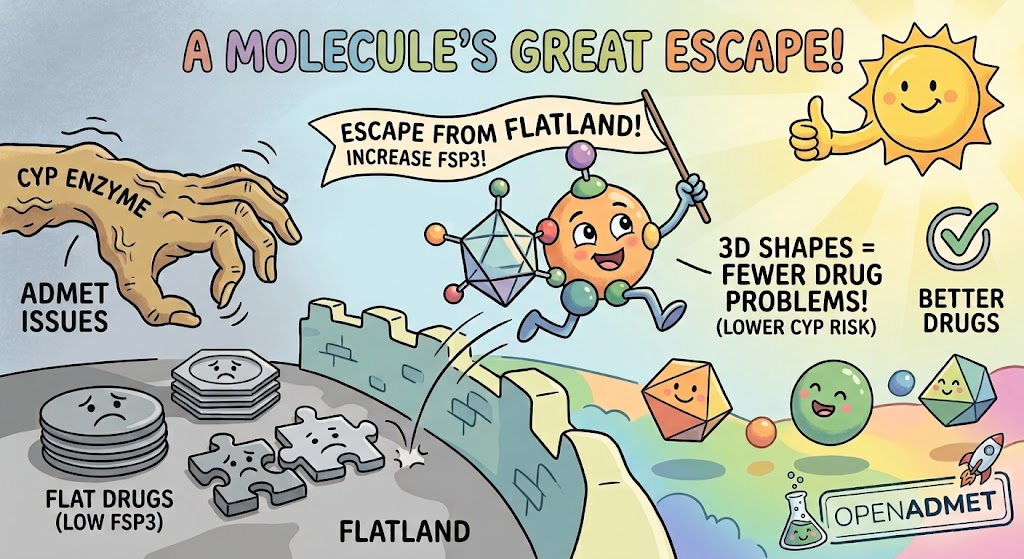
well-known example. And one way to lower the risk of CYP inhibition is
to increase Fsp3: the authors demonstrated a clear positive correlation
for CYP2C8 and CYP2C9, but no correlation for CYP3A4.
When I saw this data, I immediately thought of the trove of CYP
inhibition data from the amazing folks at Octant. I used the training
data for the ongoing OpenADMET's CYP challenge to recreate the plots
(Fig. 1). It was especially intriguing that half of the CYPs tested at
Octant differ from those listed in the paper. My observations are:
-
There's no clear correlation for CYP2D6, which tracks with its
preference for basic amines protonated at physiological conditions.[5] -
Contrary to the paper's findings, there is a weak correlation for
CYP3A4. Although its binding site is larger and more promiscuous than
those of the other CYPs, it favors aromatic nitrogens and lipophilic
molecules. Thus, Ritchie & Macdonald[6] observed stronger affinities
against CYP3A4 with increasing aromatic ring count -- conveniently,
this value is the opposite of Fsp3! -
Both CYP2C9 and CYP1A2 prefer aromatic substrates, so the correlation
with Fsp3 is natural.[5:1]
Overall, based on the published analysis and my modeling, pushing drug
candidates out of plane seems like a promising strategy to address some
pesky ADMET issues.

Fig. 1. Correlation between Fsp3 and CYP inhibition for the training
data from OpenADMET's CYP challenge.
Lipinski, C. A.; Lombardo, F.; Dominy, B. W.; Feeney, P. J. Experimental and Computational Approaches to Estimate Solubility and Permeability in Drug Discovery and Development Settings. Adv. Drug Deliv. Rev. 2001, 46 (1--3), 3--26. https://doi.org/10.1016/S0169-409X(00)00129-0 ↩︎
Wager, T. T.; Hou, X.; Verhoest, P. R.; Villalobos, A. Central Nervous System Multiparameter Optimization Desirability: Application in Drug Discovery. ACS Chem. Neurosci. 2016, 7 (6), 767--775. https://doi.org/10.1021/acschemneuro.6b00029 ↩︎
Lovering, F.; Bikker, J.; Humblet, C. Escape from Flatland: Increasing Saturation as an Approach to Improving Clinical Success. J. Med. Chem. 2009, 52 (21), 6752--6756. https://doi.org/10.1021/jm901241e ↩︎
Garry, O. L.; Cheng, A. C.; Northrup, A. B.; Merchant, R. R.; Yeung, C. S. Retrospective Analysis of the Impact of the "Escape from Flatland" Publication on the Merck & Co., Inc., Small Molecule Portfolio. J. Med. Chem. 2026, 69 (14), 16279--16287. https://doi.org/10.1021/acs.jmedchem.6c01038 ↩︎
Yan, C.; Wei, G.; Jin, Z.; Li, X.; Yang, L.; Zou, L.; Yang, L. Elucidating the Substrate Specificity of Cytochrome P450 Enzymes: Insights into N- and S-Containing Small-Molecule Metabolism. Engineering 2025, 54, 229--250. https://doi.org/10.1016/j.eng.2025.07.029 ↩︎ ↩︎
Ritchie, T. J.; Macdonald, S. J. F. The Impact of Aromatic Ring Count on Compound Developability -- Are Too Many Aromatic Rings a Liability in Drug Design? Drug Discov. Today 2009, 14 (21--22), 1011--1020. https://doi.org/10.1016/j.drudis.2009.07.014 ↩︎