Scaling Blind Challenges: A New Partnership with Radial and the Astera Institute
We are excited to announce that OpenADMET has received new grant funding from Radial, the life sciences division of the Astera Institute.
Author: Pat Walters
DOI: 10.5281/zenodo.23176780
If you spend any time evaluating machine learning models for drug discovery, you know how hard it is to get a straight answer about what actually works. The literature is full of retrospective benchmarks on noisy, overused datasets, where high performance often comes from data leakage or subtle biases rather than genuine predictive power.
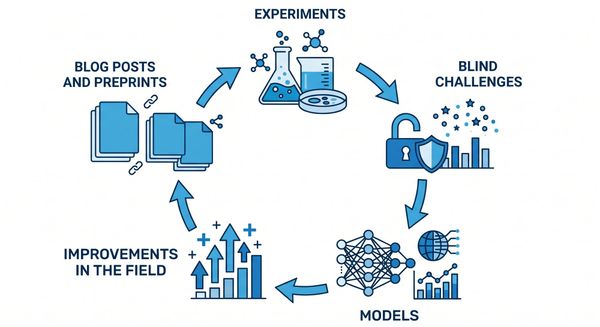
The only way out of this trap is prospective, blind evaluation of new, unreleased experimental data. But running blind challenges at scale is difficult, expensive, and technically demanding.
We are excited to announce that OpenADMET has received new grant funding from Radial, the life sciences division of the Astera Institute, to directly address this problem.
Why Astera and Radial are a Natural Fit for OpenADMET
The Astera Institute launched Radial to rethink how science is funded, engineered, and executed at a systems level. Instead of funding isolated projects that produce one-off papers, Radial focuses on foundational scientific infrastructure and new mechanisms that make research more rigorous, reproducible, and impactful.
When it comes to evaluating computational methods in chemistry and biology, the way we validate science is overdue for a reboot. Radial recognizes that establishing honest, prospective validation is not just a nice-to-have; it is a critical piece of public infrastructure needed to move the entire field forward.
This grant gives us the resources to build that infrastructure in the open.
Turning One-Off Competitions into Public Infrastructure
Whenever a team organizes an effort like CASP or CACHE, they usually end up rebuilding everything from scratch: submission portals, data ingestion pipelines, automated validation checks, and scoring scripts. That overhead keeps many organizations from running blind challenges, leaving the community stuck with retrospective benchmarks.
This grant from Radial allows OpenADMET to build a shared, reusable foundation for the entire community:
- Scalable Challenge Infrastructure: Developing open-source tools to automate dataset distribution, participant submissions, blind evaluation, and metric generation.
- The Blind Challenge Playbook: Creating a comprehensive, documented reference that outlines standards and best practices, making it straightforward for any academic lab, consortium, or organization to run its own rigorous prospective challenges.
- Living Validation Records: Moving away from static, self-reported metrics toward transparent, reproducible benchmarks where models are evaluated before anyone has been given the answer key.
Building the "CASP for ADMET"
Thirty years ago, CASP changed structural biology by demonstrating that blind validation of unreleased structures was the only reliable way to distinguish real progress from hype. CASP14 proved AlphaFold's performance because the model was tested prospectively on data it had never seen.
With Radial’s support, we are bringing that same standard of open, rigorous evaluation to small-molecule ADMET modeling.
We are grateful to Radial and the Astera Institute for supporting this vision and investing in open scientific infrastructure. You can learn more about their mission at astera.org/radial and follow our ongoing work and challenges at openadmet.org.
OpenADMET is supported by ARPA-H (under the AVOID-OME program, Award Number 1AY1AX000035), Radial and the Astera Institute (https://ror.org/00ydx1s47), Schrödinger, and the Bill & Melinda Gates Foundation. We also thank our partners Enamine, Hugging Face, OpenEye, CDD Vault, Discovery Life Sciences, and the NSLS-II beamline staff for their ongoing support.