It’s the End of the PXR Challenge as We Know It (and I feel fine)
Announcing the results of the PXR Blind Challenge — and the public release of the largest high-quality PXR induction dataset ever made available, with over 11,000 compounds.

Authors: Jon Swain, Maria Castellanos, and Hugo MacDermott-Opeskin
DOI: 10.5281/zenodo.21786098
PXR (pregnane X receptor) induction is usually discovered in mid- to late-stage lead optimization, pumping the brakes on a drug discovery program only after considerable time and money have already been spent. As a master xenobiotic sensor, PXR is directly involved in the upregulation of critical drug-metabolizing enzymes and transporters, such as CYP3A4, which metabolizes approximately 50% of all marketed drugs.
An important recent example of this liability is the COVID Moonshot’s leading non-covalent Mpro inhibitor, (S)-x38 (DNDI-6510). It was discontinued during preclinical development due to robust PXR activation, which drastically accelerated metabolic clearance and made it infeasible to maintain the continuous plasma concentrations required for antiviral efficacy.
Being able to reliably predict PXR induction early would allow drug discovery teams to prioritize compounds with the highest likelihood of clinical success. At OpenADMET, we believe that blind challenges are incredible engines for open-science innovation. To push the boundaries of what predictive models can do, we ran the PXR Blind Challenge from March 17th to July 1st, 2026.
The PXR Hall of Fame
Without further delay, we’re excited to announce the winners of the PXR Blind Challenge. The top tier of entries for each track are shown below, with the full leaderboards available later in this post, and full, interactive leaderboards available on the challenge Hugging Face space. The top tier contains all continuous entries that were not found to be statistically distinct from the top entry, with the second tier starting at the first entry that was found to be statistically distinct. The leaderboard has been filtered to only entries with a valid model report and a valid Hugging Face username as explained in the challenge rules.
Activity leaderboard
| Rank | Username | MAE | Spearman ρ | Model Report Link |
|---|---|---|---|---|
| 1 | matcha-croissant | 0.4061 ± 0.0280 | 0.8269 ± 0.0280 | Link |
| 2 | AIDD-LiLab | 0.4092 ± 0.0281 | 0.8245 ± 0.0283 | Link |
| 3 | AIDD-LiLab-Aggressive | 0.4104 ± 0.0282 | 0.8216 ± 0.0284 | Link |
| 4 | N283T | 0.4113 ± 0.0277 | 0.8161 ± 0.0257 | Link |
| 5 | toxicity | 0.4121 ± 0.0292 | 0.8107 ± 0.0290 | Link |
| 6 | tguttenb1 | 0.4139 ± 0.0267 | 0.8201 ± 0.0250 | Link |
| 7 | rdkbio | 0.4149 ± 0.0290 | 0.8095 ± 0.0288 | Link |
| 8 | Multi | 0.4152 ± 0.0286 | 0.8172 ± 0.0288 | Link |
| 9 | rasayan-labs | 0.4170 ± 0.0301 | 0.8092 ± 0.0295 | Link |
| 10 | Rasayan-ai | 0.4192 ± 0.0302 | 0.8080 ± 0.0297 | Link |
| 11 | aarshit-mittal | 0.4205 ± 0.0303 | 0.8093 ± 0.0299 | Link |
| 12 | Gashaw | 0.4213 ± 0.0296 | 0.8028 ± 0.0300 | Link |
| 13 | tibo | 0.4221 ± 0.0285 | 0.8067 ± 0.0270 | Link |
| 14 | bear | 0.4222 ± 0.0289 | 0.8141 ± 0.0278 | Link |
| 15 | discoverybytes | 0.4228 ± 0.0284 | 0.8222 ± 0.0281 | Link |
| 16 | PXRegressor | 0.4231 ± 0.0274 | 0.8154 ± 0.0266 | Link |
| 17 | asinansaglam | 0.4247 ± 0.0286 | 0.8126 ± 0.0283 | Link |
| 18 | sia | 0.4255 ± 0.0278 | 0.8167 ± 0.0264 | Link |
| 19 | volt | 0.4271 ± 0.0286 | 0.8209 ± 0.0270 | Link |
| 20 | nova | 0.4275 ± 0.0288 | 0.8035 ± 0.0286 | Link |
| 21 | cc | 0.4283 ± 0.0285 | 0.8079 ± 0.0273 | Link |
| 22 | firstpass | 0.4287 ± 0.0293 | 0.8179 ± 0.0260 | Link |
| 23 | ashoori | 0.4289 ± 0.0295 | 0.7951 ± 0.0265 | Link |
| 24 | jharrison3502 | 0.4291 ± 0.0295 | 0.8197 ± 0.0265 | Link |
| 25 | dargason | 0.4317 ± 0.0303 | 0.7617 ± 0.0344 | Link |
| 26 | PACE | 0.4322 ± 0.0295 | 0.8081 ± 0.0319 | Link |
| 27 | quockhanh212 | 0.4357 ± 0.0287 | 0.8099 ± 0.0257 | Link |
| 28 | huypn16 | 0.4360 ± 0.0287 | 0.8107 ± 0.0257 | Link |
Structure leaderboard
| Rank | Username | LDDT-PLI | BiSyRMSD | Model Report Link |
|---|---|---|---|---|
| 1 | willvith | 0.5302 ± 0.0184 | 3.6476 ± 0.1735 | Link |
| 2 | e-phy | 0.5241 ± 0.0185 | 3.6936 ± 0.1714 | Link |
| 3 | Radi | 0.5226 ± 0.0191 | 3.7524 ± 0.1835 | Link |
| 4 | bear | 0.5179 ± 0.0180 | 3.7448 ± 0.1720 | Link |
| 5 | xX-its-amit-Xx | 0.5173 ± 0.0187 | 3.8006 ± 0.1919 | Link |
| 6 | mittface | 0.5159 ± 0.0187 | 3.8178 ± 0.1925 | Link |
| 7 | NamuICT | 0.5125 ± 0.0197 | 3.8639 ± 0.2025 | Link |
| 8 | TangerineTrees | 0.5124 ± 0.0179 | 3.8245 ± 0.1722 | Link |
| 9 | dargason | 0.5118 ± 0.0176 | 3.8574 ± 0.1874 | Link |
| 10 | ver228 | 0.5114 ± 0.0183 | 3.8831 ± 0.1929 | Link |
Leaderboard analysis
To determine our final standings, the activity prediction track was ranked by Mean Absolute Error (MAE), with lower scores indicating better performance, while the structure prediction track was ranked by LDDT-PLI, with higher scores preferred. Rather than relying solely on ranking by raw scores, we implemented rigorous bootstrapping and statistical testing to evaluate the true significance of the results, as we recommended in this blog post. To maximize readability for the community, we replaced the resulting Compact Letter Display (CLD) with a streamlined "tiering" system. Tiers were established sequentially: starting with the rank-1 submission, we grouped all subsequent entries into the same tier until encountering a model that was statistically distinct. This distinct entry then defined the boundary for the next tier, allowing us to clearly delineate which model architectures achieved a genuine statistical breakout.
One of the first things to note is that lots of people did well! The top of the leaderboard was crowded with performant models, with the top tier of performance in the activity track containing 28 entries, and the top tier in the structure track containing 10. A new tier starts when a model was found to have statistically distinct performance from the top model in a tier. Because a new tier only triggers when an entry becomes statistically distinct from the top model of the current tier, users might notice a classic statistical quirk: a model further down the leaderboard may not be statistically distinct from an entry in a higher tier (even the top model in that tier). This is a natural result of the non-transitive nature of statistical significance, but adopting this sequential approach allowed us to present clean, continuous tiers across the entire cohort.
In our activity track, we evaluated 100 entries, which translated to a matrix of 4,950 pairwise rank comparisons. We found that applying the conservative Holm-Bonferroni correction to control the family-wise error rate heavily penalised our statistical power and resulted in overly crowded, ambiguous tiers. We've changed this to use the Benjamini-Hochberg procedure to control the False Discovery Rate (FDR) at 5%. This transition dramatically improves the statistical power of our pipeline, allowing us to achieve much higher resolution when differentiating between closely ranked, high-performing models. By controlling the FDR, we accept the statistical reality that up to 5% of the pairwise comparisons flagged as "statistically distinct" across this massive matrix could be false discoveries. This minor trade-off prevents the test from being underpowered, ensuring that genuine differences at the top of the leaderboard are clearly represented.
Head-to-head comparisons
Want to see how your entry compares to the winner? We’ve added a new tab to the challenge Hugging Face space which allows you to to compare two entries. It provides a summary of the statistics used to determine if the entries are statistically distinct, a summary of their performance across the bootstrap samples, and a per-molecule comparison which allows you to see exactly which molecules each model performed better on.
The largest ever publicly released PXR dataset
Activity dataset
The activity data released for the PXR Blind Challenge represent the largest, most consistent, high-quality dataset of PXR induction ever made publicly available. Prior to this, there were fewer than 800 high-quality pEC50 values in ChEMBL. On Hugging Face, we released data for over 11,000 compounds generated using Octant’s low-cost, high-fidelity in-house assay, including full dose-response data for over 4,000 of them. Now that the challenge has concluded, we are unblinding the entire test set, adding 260 compounds to the 253 previously released at the end of Phase 1, for a total of 513 compounds. The data released mimics a real-world lead optimisation scenario, shifting from broad hit-finding to detailed exploration of Structure-Activity Relationships (SAR). The test set contains detailed SAR and activity cliffs that proved challenging for models. Kudos to our friends at Octant, as this represents the first OpenADMET challenge (of many to come) run tip to tail with data generated in-house.
Structure dataset
We have also unblinded our structure dataset to provide a comprehensive view of PXR's remarkable binding flexibility. Determined by the Fraser Lab at UCSF, this dataset contains high-quality X-ray crystal structures for 184 small molecules, ranging from fragment-sized compounds to highly active molecules pulled from the activity track.
To generate the bound structures, fragments were soaked into apo crystals at a nominal concentration of 10 mM, with X-ray diffraction data subsequently collected at NSLS-II using the AMX and FMX beamlines. Following data reduction via Autoproc, electron density maps were systematically analyzed for fragment binding events using PanDDA. The final binding poses were modeled in COOT and polished with phenix.refine. To complement these new structural data, 68 structures from the PDB have been re-refined and were released as part of the structure data package.
Two tracks, two phases, many winners
The OpenADMET PXR Blind Challenge had a unique structure. We had two parallel tracks (activity prediction and structure prediction), with participants able to take part in either or both.
- The activity prediction track was a traditional tabular-data prediction task, in which participants were asked to predict pEC50 values.
- The structure prediction track asked participants to predict the three-dimensional structure of the ligands bound within the highly flexible PXR.
To simulate the evolving nature of a real-world drug discovery program, the activity track was executed in two phases. During Phase 1, a live leaderboard was maintained on our Hugging Face Space, providing real-time feedback on half of the evaluation compounds (known as Analog Set 1). At the conclusion of Phase 1, we captured a one-off snapshot of model performance across the entire test set (both Analog Sets 1 and 2) to generate an interim leaderboard, immediately followed by the public unblinding of Analog Set 1.
With this unblinding, participants needed to react to the new data and fine-tune their methods accordingly. During Phase 2, there was no live leaderboard, so participants had to wait until the end of the challenge to see their models' performance on Analog Set 2. Not overfitting was key here! In contrast, the structure track maintained a live leaderboard across both phases, continuously evaluating submissions on half of the structural test set.
Today, the wait is over. With the release of our final leaderboards, we can officially crown our winners. To ensure a definitive assessment, the final activity prediction standings are evaluated strictly on the hidden Analog Set 2, whereas the final structure prediction standings are evaluated across the entire structural test set.
The PXR challenge in numbers
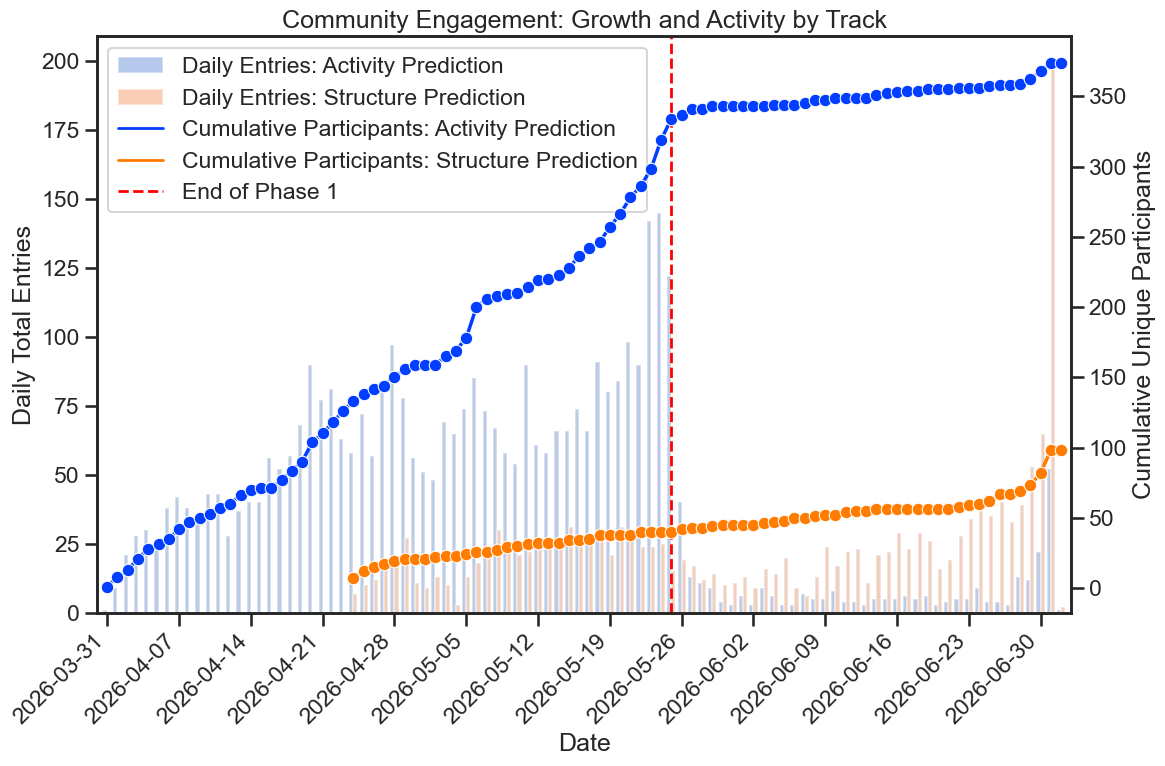
We’ve been blown away by the engagement we’ve seen from the community on this blind challenge. Following our successful previous blind challenges (ASAP-Polaris Antiviral Challenge and the OpenADMET-ExpansionRx Blind Challenge), we’re excited to see the momentum continuing. The success of these challenges relies on the involvement and commitment of our participants, who continue to push the boundaries of ADMET prediction, so a huge thank you to everyone who took part.
We had over 350 unique participants in the activity track and nearly 100 unique participants in the structure track. The community submitted over 5,500 entries, with 130 total model reports, and generated nearly 800 posts in our Discord channel.
Next steps: Phase 3?
As the dust settles on another OpenADMET Blind Challenge, we’re busy working away behind the scenes. We’re analyzing the submitted model reports and will produce and share a summary of what worked and what didn't within the next few weeks. These summaries will be expanded on for a collaborative preprint in the coming months. All challenge participants who submitted a valid model report will be invited to be co-authors on this preprint.
As with our previous blind challenges, we’ll also invite representatives from some of the top teams to discuss their methods in upcoming webinars. As many people did well, we will select a variety of model architectures and approaches for presentations.
We really value your feedback, so we’ve also prepared this participant survey. The survey will also be emailed out to everyone who provided an address when submitting an entry.
Finally, we’ll be running more blind challenges, with the next one being announced very soon. Watch this space!
With a little help from our friends
We want to thank the teams at Octant and UCSF (Fraser Lab) for all their hard work in making this challenge possible. In particular, we would like to thank Sam Sabaat, Scott Simpkins, Yuning Shen, Bryan Jiang, Henry Chan, Jeff Tang, Ayesha Ghazali, Theo Tarver, Steven Edgar, Dominic Ky, and many others from Octant, as well as Galen Correy, Yagmur Doruk, Nikhil Gupta, and the Fraser Lab at UCSF.
We would like to thank our funders for their support of OpenADMET, in particular ARPAH, Radial (part of the Astera Institute), Schrodinger Inc, and the Gates Foundation. We would also like to thank our partners Enamine, HuggingFace, OpenEye, CDD Vault, and Discovery Life Sciences for their support.
The full leaderboards
Activity leaderboard
| Rank | Username | Significance (tiers) | MAE | Spearman ρ | Model Report Link |
|---|---|---|---|---|---|
| 1 | matcha-croissant | Tier 1 | 0.4061 ± 0.0280 | 0.8269 ± 0.0280 | Link |
| 2 | AIDD-LiLab | Tier 1 | 0.4092 ± 0.0281 | 0.8245 ± 0.0283 | Link |
| 3 | AIDD-LiLab-Aggressive | Tier 1 | 0.4104 ± 0.0282 | 0.8216 ± 0.0284 | Link |
| 4 | N283T | Tier 1 | 0.4113 ± 0.0277 | 0.8161 ± 0.0257 | Link |
| 5 | toxicity | Tier 1 | 0.4121 ± 0.0292 | 0.8107 ± 0.0290 | Link |
| 6 | tguttenb1 | Tier 1 | 0.4139 ± 0.0267 | 0.8201 ± 0.0250 | Link |
| 7 | rdkbio | Tier 1 | 0.4149 ± 0.0290 | 0.8095 ± 0.0288 | Link |
| 8 | Multi | Tier 1 | 0.4152 ± 0.0286 | 0.8172 ± 0.0288 | Link |
| 9 | rasayan-labs | Tier 1 | 0.4170 ± 0.0301 | 0.8092 ± 0.0295 | Link |
| 10 | Rasayan-ai | Tier 1 | 0.4192 ± 0.0302 | 0.8080 ± 0.0297 | Link |
| 11 | aarshit-mittal | Tier 1 | 0.4205 ± 0.0303 | 0.8093 ± 0.0299 | Link |
| 12 | Gashaw | Tier 1 | 0.4213 ± 0.0296 | 0.8028 ± 0.0300 | Link |
| 13 | tibo | Tier 1 | 0.4221 ± 0.0285 | 0.8067 ± 0.0270 | Link |
| 14 | bear | Tier 1 | 0.4222 ± 0.0289 | 0.8141 ± 0.0278 | Link |
| 15 | discoverybytes | Tier 1 | 0.4228 ± 0.0284 | 0.8222 ± 0.0281 | Link |
| 16 | PXRegressor | Tier 1 | 0.4231 ± 0.0274 | 0.8154 ± 0.0266 | Link |
| 17 | asinansaglam | Tier 1 | 0.4247 ± 0.0286 | 0.8126 ± 0.0283 | Link |
| 18 | sia | Tier 1 | 0.4255 ± 0.0278 | 0.8167 ± 0.0264 | Link |
| 19 | volt | Tier 1 | 0.4271 ± 0.0286 | 0.8209 ± 0.0270 | Link |
| 20 | nova | Tier 1 | 0.4275 ± 0.0288 | 0.8035 ± 0.0286 | Link |
| 21 | cc | Tier 1 | 0.4283 ± 0.0285 | 0.8079 ± 0.0273 | Link |
| 22 | firstpass | Tier 1 | 0.4287 ± 0.0293 | 0.8179 ± 0.0260 | Link |
| 23 | ashoori | Tier 1 | 0.4289 ± 0.0295 | 0.7951 ± 0.0265 | Link |
| 24 | jharrison3502 | Tier 1 | 0.4291 ± 0.0295 | 0.8197 ± 0.0265 | Link |
| 25 | dargason | Tier 1 | 0.4317 ± 0.0303 | 0.7617 ± 0.0344 | Link |
| 26 | PACE | Tier 1 | 0.4322 ± 0.0295 | 0.8081 ± 0.0319 | Link |
| 27 | quockhanh212 | Tier 1 | 0.4357 ± 0.0287 | 0.8099 ± 0.0257 | Link |
| 28 | huypn16 | Tier 1 | 0.4360 ± 0.0287 | 0.8107 ± 0.0257 | Link |
| 29 | jaybirdy | Tier 2 | 0.4365 ± 0.0274 | 0.7968 ± 0.0284 | Link |
| 30 | minhpham-2003 | Tier 2 | 0.4370 ± 0.0287 | 0.8142 ± 0.0257 | Link |
| 31 | jeremy | Tier 2 | 0.4380 ± 0.0285 | 0.7916 ± 0.0297 | Link |
| 32 | sandeepbii | Tier 2 | 0.4389 ± 0.0291 | 0.7959 ± 0.0259 | Link |
| 33 | auP7s | Tier 2 | 0.4393 ± 0.0287 | 0.8075 ± 0.0281 | Link |
| 34 | chempxr | Tier 2 | 0.4393 ± 0.0285 | 0.8063 ± 0.0283 | Link |
| 35 | Uncertain-Tea | Tier 2 | 0.4403 ± 0.0296 | 0.8013 ± 0.0314 | Link |
| 36 | objective-santi | Tier 2 | 0.4417 ± 0.0290 | 0.8103 ± 0.0282 | Link |
| 37 | PeterBloomingdale | Tier 2 | 0.4418 ± 0.0296 | 0.8102 ± 0.0282 | Link |
| 38 | sbot-v3 | Tier 2 | 0.4427 ± 0.0288 | 0.8017 ± 0.0282 | Link |
| 39 | Radi | Tier 2 | 0.4442 ± 0.0292 | 0.7704 ± 0.0317 | Link |
| 40 | briford | Tier 2 | 0.4443 ± 0.0320 | 0.7716 ± 0.0326 | Link |
| 41 | pavankum | Tier 2 | 0.4471 ± 0.0296 | 0.7955 ± 0.0316 | Link |
| 42 | TakuyaPKPD | Tier 2 | 0.4492 ± 0.0301 | 0.7911 ± 0.0302 | Link |
| 43 | reillyosadchey | Tier 2 | 0.4507 ± 0.0299 | 0.8032 ± 0.0266 | Link |
| 44 | KalenJosifovski | Tier 2 | 0.4519 ± 0.0301 | 0.7818 ± 0.0306 | Link |
| 45 | HungryCapybara | Tier 2 | 0.4564 ± 0.0295 | 0.7563 ± 0.0342 | Link |
| 46 | adlvdl | Tier 2 | 0.4573 ± 0.0303 | 0.7794 ± 0.0318 | Link |
| 47 | leeherman99 | Tier 2 | 0.4590 ± 0.0306 | 0.7615 ± 0.0328 | Link |
| 48 | tiuel | Tier 2 | 0.4591 ± 0.0303 | 0.7789 ± 0.0305 | Link |
| 49 | kulkakulka | Tier 2 | 0.4592 ± 0.0282 | 0.7661 ± 0.0337 | Link |
| 50 | myco | Tier 2 | 0.4592 ± 0.0286 | 0.7700 ± 0.0319 | Link |
| 51 | elli3tiu | Tier 2 | 0.4607 ± 0.0309 | 0.7906 ± 0.0294 | Link |
| 52 | ellieberry | Tier 2 | 0.4625 ± 0.0302 | 0.7699 ± 0.0332 | Link |
| 53 | Usagi | Tier 2 | 0.4632 ± 0.0309 | 0.7804 ± 0.0294 | Link |
| 54 | xX-its-amit-Xx | Tier 2 | 0.4659 ± 0.0301 | 0.7612 ± 0.0332 | Link |
| 55 | JacksonBurns | Tier 2 | 0.4666 ± 0.0294 | 0.7774 ± 0.0328 | Link |
| 56 | ldbc1999 | Tier 2 | 0.4688 ± 0.0297 | 0.7852 ± 0.0292 | Link |
| 57 | namuICT | Tier 3 | 0.4694 ± 0.0298 | 0.7830 ± 0.0313 | Link |
| 58 | IAB | Tier 3 | 0.4699 ± 0.0294 | 0.7675 ± 0.0312 | Link |
| 59 | mthomasm | Tier 3 | 0.4702 ± 0.0284 | 0.7954 ± 0.0262 | Link |
| 60 | KNIMEST | Tier 3 | 0.4717 ± 0.0311 | 0.7573 ± 0.0337 | Link |
| 61 | chaospilot | Tier 3 | 0.4726 ± 0.0322 | 0.7427 ± 0.0374 | Link |
| 62 | DenaliSchlesinger | Tier 3 | 0.4744 ± 0.0311 | 0.7270 ± 0.0377 | Link |
| 63 | itetko | Tier 3 | 0.4753 ± 0.0299 | 0.7763 ± 0.0322 | Link |
| 64 | QuantNova | Tier 3 | 0.4797 ± 0.0343 | 0.7296 ± 0.0415 | Link |
| 65 | DMakarov | Tier 3 | 0.4799 ± 0.0296 | 0.7510 ± 0.0339 | Link |
| 66 | cat554 | Tier 3 | 0.4801 ± 0.0325 | 0.7656 ± 0.0305 | Link |
| 67 | Zugspitze | Tier 3 | 0.4830 ± 0.0309 | 0.7511 ± 0.0320 | Link |
| 68 | wuhicky | Tier 3 | 0.4849 ± 0.0321 | 0.7603 ± 0.0318 | Link |
| 69 | lbaweja21 | Tier 3 | 0.4876 ± 0.0299 | 0.7843 ± 0.0266 | Link |
| 70 | avaliev | Tier 3 | 0.4889 ± 0.0302 | 0.7455 ± 0.0359 | Link |
| 71 | Schnappi | Tier 3 | 0.4893 ± 0.0311 | 0.7464 ± 0.0321 | Link |
| 72 | mp-alex | Tier 3 | 0.4919 ± 0.0288 | 0.7596 ± 0.0301 | Link |
| 73 | Asidsal11 | Tier 3 | 0.4932 ± 0.0315 | 0.7294 ± 0.0384 | Link |
| 74 | duoduo6 | Tier 3 | 0.4933 ± 0.0338 | 0.7603 ± 0.0318 | Link |
| 75 | BalamuruganThirukonda | Tier 3 | 0.4938 ± 0.0315 | 0.7566 ± 0.0316 | Link |
| 76 | admet-challenger | Tier 3 | 0.4954 ± 0.0305 | 0.7566 ± 0.0329 | Link |
| 77 | axelrolov | Tier 3 | 0.4957 ± 0.0316 | 0.7251 ± 0.0349 | Link |
| 78 | Srajall | Tier 4 | 0.4963 ± 0.0321 | 0.7344 ± 0.0353 | Link |
| 79 | SystemsCBLab | Tier 4 | 0.5012 ± 0.0299 | 0.7414 ± 0.0347 | Link |
| 80 | Kutoynash | Tier 4 | 0.5028 ± 0.0311 | 0.7506 ± 0.0316 | Link |
| 81 | MaryumIrs | Tier 4 | 0.5030 ± 0.0297 | 0.7144 ± 0.0370 | Link |
| 82 | CASPER-single-descriptor-set-model | Tier 4 | 0.5046 ± 0.0311 | 0.7231 ± 0.0366 | Link |
| 83 | duod | Tier 4 | 0.5058 ± 0.0323 | 0.7569 ± 0.0305 | Link |
| 84 | zhou-shan-shui | Tier 4 | 0.5106 ± 0.0311 | 0.7187 ± 0.0366 | Link |
| 85 | lxduo | Tier 4 | 0.5134 ± 0.0327 | 0.7398 ± 0.0329 | Link |
| 86 | ubiqtuitin | Tier 4 | 0.5159 ± 0.0307 | 0.7197 ± 0.0335 | Link |
| 87 | Whitebox | Tier 4 | 0.5234 ± 0.0340 | 0.6953 ± 0.0363 | Link |
| 88 | apxjmd | Tier 4 | 0.5253 ± 0.0317 | 0.6894 ± 0.0386 | Link |
| 89 | Shorku | Tier 4 | 0.5289 ± 0.0328 | 0.6721 ± 0.0363 | Link |
| 90 | nyota | Tier 4 | 0.5342 ± 0.0325 | 0.6715 ± 0.0376 | Link |
| 91 | busy-beaver | Tier 4 | 0.5414 ± 0.0301 | 0.7218 ± 0.0340 | Link |
| 92 | zero_da2 | Tier 5 | 0.5520 ± 0.0319 | 0.6537 ± 0.0402 | Link |
| 93 | ChAndersen | Tier 5 | 0.5531 ± 0.0297 | 0.7269 ± 0.0352 | Link |
| 94 | APX_bcoke | Tier 5 | 0.5716 ± 0.0322 | 0.6705 ± 0.0394 | Link |
| 95 | hangyodon | Tier 5 | 0.5781 ± 0.0332 | 0.7029 ± 0.0353 | Link |
| 96 | k3785331526 | Tier 5 | 0.5795 ± 0.0331 | 0.7033 ± 0.0349 | Link |
| 97 | JazminOliveri | Tier 6 | 0.5987 ± 0.0320 | 0.6396 ± 0.0420 | Link |
| 98 | JustLeonard | Tier 7 | 0.6712 ± 0.0344 | 0.4844 ± 0.0466 | Link |
| 99 | agitter | Tier 8 | 0.7185 ± 0.0350 | 0.3868 ± 0.0529 | Link |
| 100 | VIDraft | Tier 9 | 1.0339 ± 0.0334 | 0.5181 ± 0.0488 | Link |
Structure leaderboard
| Rank | Username | Significance (tiers) | LDDT-PLI | BiSyRMSD | Model Report Link |
|---|---|---|---|---|---|
| 1 | willvith | Tier 1 | 0.5302 ± 0.0184 | 3.6476 ± 0.1735 | Link |
| 2 | e-phy | Tier 1 | 0.5241 ± 0.0185 | 3.6936 ± 0.1714 | Link |
| 3 | Radi | Tier 1 | 0.5226 ± 0.0191 | 3.7524 ± 0.1835 | Link |
| 4 | bear | Tier 1 | 0.5179 ± 0.0180 | 3.7448 ± 0.1720 | Link |
| 5 | xX-its-amit-Xx | Tier 1 | 0.5173 ± 0.0187 | 3.8006 ± 0.1919 | Link |
| 6 | mittface | Tier 1 | 0.5159 ± 0.0187 | 3.8178 ± 0.1925 | Link |
| 7 | NamuICT | Tier 1 | 0.5125 ± 0.0197 | 3.8639 ± 0.2025 | Link |
| 8 | TangerineTrees | Tier 1 | 0.5124 ± 0.0179 | 3.8245 ± 0.1722 | Link |
| 9 | dargason | Tier 1 | 0.5118 ± 0.0176 | 3.8574 ± 0.1874 | Link |
| 10 | ver228 | Tier 1 | 0.5114 ± 0.0183 | 3.8831 ± 0.1929 | Link |
| 11 | dnan-ipd | Tier 2 | 0.5050 ± 0.0185 | 3.9038 ± 0.1804 | Link |
| 12 | suspenders | Tier 2 | 0.5025 ± 0.0175 | 3.7689 ± 0.1706 | Link |
| 13 | davis4better | Tier 2 | 0.5020 ± 0.0181 | 3.8361 ± 0.1703 | Link |
| 14 | florian-wuennemann | Tier 2 | 0.4942 ± 0.0176 | 3.9444 ± 0.1708 | Link |
| 15 | nova | Tier 2 | 0.4938 ± 0.0178 | 3.9215 ± 0.1749 | Link |
| 16 | UCL_UCTPrague | Tier 2 | 0.4846 ± 0.0197 | 4.7188 ± 0.3569 | Link |
| 17 | pavankum | Tier 3 | 0.4722 ± 0.0176 | 4.1106 ± 0.1726 | Link |
| 18 | discoverybytes | Tier 3 | 0.4682 ± 0.0171 | 4.1406 ± 0.1706 | Link |
| 19 | TCB | Tier 3 | 0.4658 ± 0.0184 | 4.4302 ± 0.2468 | Link |
| 20 | Cryo-EMinem | Tier 3 | 0.4649 ± 0.0175 | 4.1694 ± 0.1747 | Link |
| 21 | JacksonBurns | Tier 3 | 0.4523 ± 0.0170 | 4.3610 ± 0.1903 | Link |
| 22 | SystemsCBLab | Tier 4 | 0.4407 ± 0.0168 | 4.4041 ± 0.1829 | Link |
| 23 | Srajall | Tier 4 | 0.4380 ± 0.0167 | 4.4096 ± 0.1731 | Link |
| 24 | sbhakat | Tier 4 | 0.4353 ± 0.0150 | 4.4611 ± 0.1714 | Link |
| 25 | rdkbio | Tier 4 | 0.4243 ± 0.0166 | 5.3711 ± 0.4667 | Link |
| 26 | JazminOliveri | Tier 5 | 0.3904 ± 0.0147 | 4.9071 ± 0.1609 | Link |
| 27 | jeremy | Tier 6 | 0.3370 ± 0.0154 | 5.7266 ± 0.2388 | Link |
| 28 | covalent | Tier 6 | 0.3168 ± 0.0116 | 5.4221 ± 0.1491 | Link |
| 29 | Banjo Gopher finalv2 | Tier 7 | 0.2649 ± 0.0125 | 6.4340 ± 0.1890 | Link |
| 30 | openadmet-DOCK-baseline-Kyrylchuk | Tier 7 | 0.2361 ± 0.0100 | 6.7197 ± 0.1388 | Link |