OpenADMET Quarterly Newsletter Q2 2026
Our quarterly newsletter detailing our progress, goals and priorities.

Authors: Pat Walters
DOI: 10.5281/zenodo.21789318.
Welcome to the first in a series of quarterly newsletters detailing our progress, goals, and priorities. OpenADMET provides the drug discovery ecosystem with high-fidelity data, structural insights, and predictive models to identify and mitigate ADMET liabilities.
Our core scientific effort centers on systematically characterizing the "Avoid-ome", which is a network of essential metabolic enzymes, nuclear receptors, and transporters that act as biological anti-targets. Because unexpected interactions here can lead to toxicity, poor pharmacokinetics, or drug-drug interactions, building accurate predictive models is essential.
To break traditional drug discovery bottlenecks, we integrate four highly coordinated operational pillars:
- Large Open Datasets: We generate large, high-quality datasets to build the foundational data infrastructure that the public domain currently lacks.
- Structural Biology Ground Truth: Our X-ray crystallography and cryoEM work provides the ligand-bound conformations needed to validate and benchmark structure-based AI on flexible anti-targets.
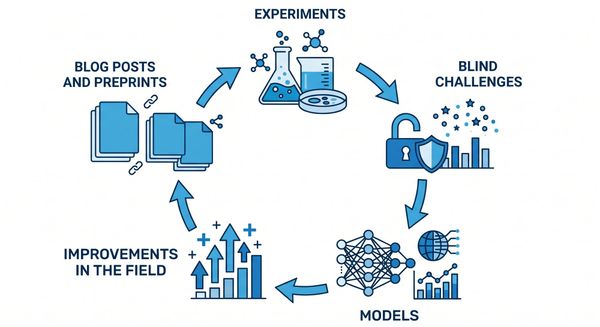
- Prospective Community Blind Challenges: By evaluating computational models against completely unpublished, prospective data, we stress-test and surface the most performant predictive architectures in real-time.
- Open Models Trained on Curated Data: We train best-in-class models on carefully curated public and project-generated data. These baselines will keep improving as our blind challenges push frontier model performance forward
By the Numbers
Since the consortium's inception, OpenADMET has:
- Generated nearly 150,000 measurements across more than 30,000 compounds: the largest publicly available ADMET datasets worldwide, representing a more than 10x increase in publicly available data.
- Solved 184 co-crystal structures of small molecules bound to PXR, effectively tripling the publicly available data for this target.
- Run three highly successful blind challenges, with the two most recent each attracting more than 350 groups.
These efforts have catalyzed the community to produce blog posts, videos, and a dedicated two-day conference.
Near-Term Priorities
As further detailed in the OpenADMET Conference Report, our near-term operational focus is directed toward three main objectives:
- Assay and Data Generation: Scaling high-throughput screening pipelines to complete baseline coverage across the remaining metabolism anti-targets and solving target structures to fuel downstream modeling.
- Prospective Model Evaluation: Continuing our cadence of community blind challenges to prospectively evaluate machine learning models, uncovering where current architectures fail and where we must improve open-source modeling. Our blind challenge series is the densest run of novel dataset blind challenges ever executed in the drug discovery field, designed to systematically stress-test machine learning architectures against completely unpublished, prospective data.
- Catalyzing the Community: Lowering the barrier to entry by delivering highly collaborative platforms, including interactive webinars, deep-dive blog posts, and our annual conference, to share insights and spark global innovation across computational chemistry.
Research Progress
This quarter, our teams made substantial gains in performance across data generation, structural characterization, and computational modeling. Octant advanced our metabolic profiling by screening over 20,000 unique molecules across PXR and the four predominant CYP isoforms, yielding the largest consistently generated publicly available datasets to date. Concurrently, the UCSF team solved 184 X-ray crystal structures of the Pregnane X Receptor to support our current blind challenge, while establishing cryoEM systems for CYP3A4 and hERG to provide key insights into these critical Avoid-ome targets. Finally, the OMSF team deployed these prospective datasets to run the PXR Blind Challenge, drawing over 350 international groups, while successfully expanding structure-based modeling capabilities through fine-tuning collaborations with the OpenFold team.
Key Dataset Releases
In alignment with our core pillar of providing high-quality open data to the public domain, we formalized several key releases this quarter to fuel downstream computational modeling:
- March: Released the CYP inhibition and reactivity datasets, covering foundational baseline metrics for CYP inhibition and Reaction Phenotyping.
- April: Released the PXR Challenge Training Set to the global scientific community, enabling participants to download, benchmark, and calibrate their predictive machine learning models prior to the challenge evaluation phase.
- July: Released the PXR Challenge Test Set, providing the final prospective benchmark data needed to evaluate model submissions and determine the challenge's closing performance metrics.
Blog Posts
OpenADMET views blog posts as a high-velocity way to get key scientific findings, data updates, and in-depth dives into targets into the hands of the scientific community. Alongside posts tracking our model releases and blind challenge progress, we've published several pieces on our assay design, computational methods, and structural biology work:
Our first data release: CYP inhibition and reaction phenotyping data on ~1,200 compounds, generated at Octant using miniaturized assays and high-throughput mass spectrometry. We evaluate the cost, capacity, and confidence trade-offs associated with the assays and make the case for sharing well-level data rather than summary statistics alone.
We benchmarked popular public ADME models against the blinded ExpansionRx test set to ask whether models trained on public data can extrapolate to novel chemistry. The short answer: not yet; fine-tuning on project data beats training on the public corpus alone, with few exceptions.
All 66 liganded PXR structures in the PDB were re-refined with modern protocols to assess effects on model quality. Improvements were made, with the effect most pronounced for older depositions, underscoring that not all PDB entries should be treated as fixed ground truth for training or benchmarking.
A deep dive into the statistics of comparing blind challenge entries. We show that our original bootstrap-plus-Tukey approach was overpowered, compare four alternatives, settle on paired bootstrap confidence intervals with a multiple-hypothesis-testing correction, and confirm the rankings from our previous challenges.
Can a model steer its own data acquisition? Across two retrospective analyses, we demonstrate that active learning with a greedy acquisition function recovers hits quickly and at only a modest cost to model accuracy.
High-throughput chemistry lets us screen crude reaction mixtures directly, enabling SAR exploration at scale; however, unknown yields obscure the amount of compound actually present in each well. We describe a standard-free UHPLC-CAD-MS workflow that quantifies each product without per-compound reference standards, enabling the determination of yield-corrected potencies and the release of ~450 novel PXR EC50 values as training data for our PXR blind challenge.
Some claim that cofolding models have revolutionized computational structural biology, but how well do they work for key ADMET targets? Analysis of performance on PXR and CYP3A4 shows strong protein backbone performance but frequently misplaced ligands, even for complexes the models were trained on. Part one of a series stress-testing cofolding strategies on anti-targets.
- Not invited to the party? How to make proprietary ADMET insights more accessible If proprietary data can't be shared, can the knowledge it contains be shared? Using a large dataset from Novartis, we test ML-predicted surrogate labels as stand-ins for proprietary measurements and show that they capture real signal for some endpoints, in some cases rivaling or exceeding the entire corpus of public data.
Building Community
Our collaborative ecosystem reached a major milestone this quarter with the inaugural OpenADMET conference held June 22 and 23 at UCSF, bringing together consortium teams, industry leaders, and blind challenge participants to discuss results and set future strategic directions. Beyond this baseline event, community engagement has flourished through interactive channels. We hosted a series of candid technical webinars featuring top-performing challenge participants, which are archived on our YouTube channel and routinely generate hundreds of views. Additionally, our teams and community members engage in active scientific dialogue across our Discord server and public media, highlighted by 13 technical blog posts published since March, as well as independent, multi-part deep dives from participant contributors.
Looking Ahead
As OpenADMET moves forward, we remain dedicated to our mission of closing critical gaps in therapeutic safety and predictive modeling. The progress made this quarter, from the generation of unprecedented datasets to the active engagement of our growing community, demonstrates the power of collaborative science.
We are deeply grateful for the valuable connections that our community and supporters provided over the last year. Please continue to connect us with other teams whose work may complement our research, so we can expand our shared scientific network.
Looking closely at the upcoming calendar, we are excited to expand our prospective evaluation pipeline with two major community blind challenges:
- August: We will launch our next blind challenge, featuring comprehensive CYP3A4, CYP2D6, CYP2C19, and CYP1A2 inhibition data newly generated at Octant.
- December: We will host a follow-on challenge featuring robust ADMET data provided by our partners and fellow ARPA-H performers at Phare Bio.
We look forward to continuing this momentum, deepening our understanding of the Avoid-ome, and empowering researchers worldwide with the data and tools needed to accelerate safer, more efficient drug discovery.
Thank you for your continued support.
We would like to thank our funders for their support of OpenADMET, in particular ARPAH, Radial (part of the Astera Institute (https://ror.org/00ydx1s47)), Schrödinger Inc, and the Gates Foundation. We would also like to thank our partners Enamine, HuggingFace, OpenEye, CDD Vault, Discovery Life Sciences, and the beamline staff at NSLS-II for their support. This work is supported by the Advanced Research Projects Agency for Health (ARPA-H) under AVOID-OME, and Award Number 1AY1AX000035. The contents are those of the authors. They may not reflect the policies of the Department of Health and Human Services or the U.S. government. The content is solely the responsibility of the authors and does not necessarily represent the official views of the Advanced Research Projects Agency for Health.